Carrera del Darro, Granada
13 min read
Written by official guides
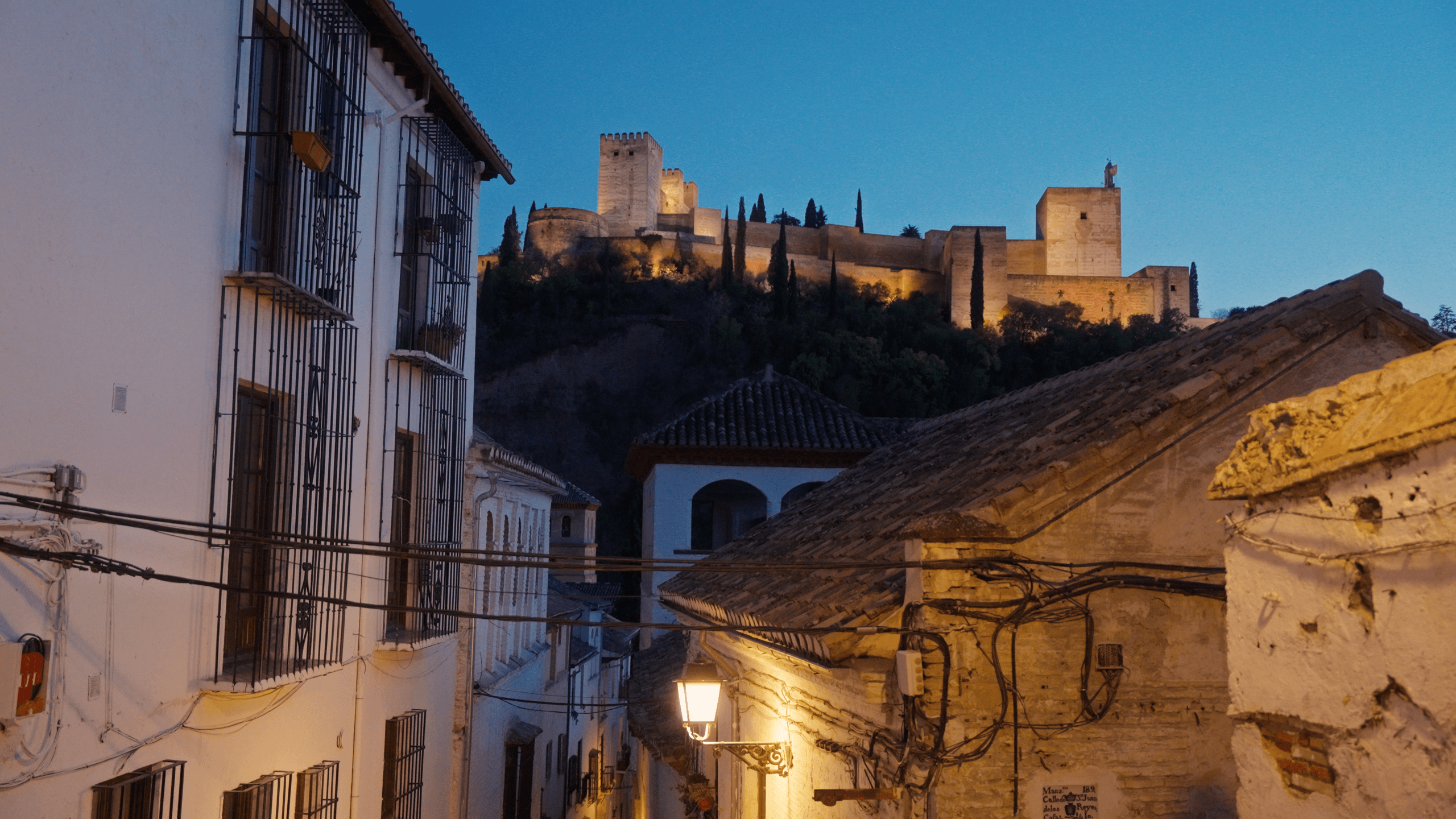
The Carrera del Darro runs along the right bank of the river Darro, one of the three rivers that cross Granada. The Darro is a tributary of the Genil. It starts in Plaza Nueva and ends next to the Puente del Aljibillo, a crossroads where the Cuesta del Chapiz towards the Albaicín and Sacromonte meets the Cuesta del Rey Chico or Cuesta de los Chinos towards the Alhambra.
Along its banks are 17th-century bridges, 11th-century Arab baths, convents, Nasrid palaces, the Archaeological Museum of Granada and the Church of San Pedro y San Pablo. It connects the Albaicín hill with the Sabika hill where the Alhambra stands. In the Nasrid period it was an urban axis and commercial area known as the Ajsaris quarter.
After 1492 the Catholic Monarchs allowed its present layout, with Renaissance and Baroque manor houses. It is popularly known as the Paseo de los Tristes because funeral processions passed along it on their way to Granada's cemetery until the 20th century.
Historical background of the Carrera del Darro
Islamic period (11th–15th centuries)
In the time of the Zirid kingdom, the Islamic taifa kingdom that controlled the Granada area for most of the 11th century, the hill now occupied by the Albaicín, on the right bank of the river, was inhabited. This is the oldest inhabited part of the city of Granada. On the left bank, facing the Albaicín hill, is the Sabika hill, crowned today by the Alhambra. Although the Alhambra did not yet exist in the 11th century, there was a smaller fortress on this hill, of great strategic importance for its view over the Darro and Genil valleys and the plain of the Vega de Granada.
Connecting the two hills was a coracha (fortified path) that crossed the river on a bridge with a gate to prevent any intruder from entering along the riverbed. Of this gate, known as the Puerta de los Tableros, only a few remains survive today: the springing of the arch on the left bank of the river. Right opposite these remains are two important monuments from the Islamic period: the Bañuelo (an 11th-century hammam or Arab bathhouse, the best preserved in all of al-Andalus) and the Maristán (a 14th-century hospital).
During the Nasrid period (13th–15th centuries), the river Darro remained fundamental to the city, as both a water source and an urban axis. Arab baths or hammams, mills, bridges and Morisco houses were built along its banks. This area was known as the Ajsaris quarter and was of notable commercial and residential importance.
Christian period (from 1492)
After the Catholic Monarchs conquered Granada in 1492, the Carrera del Darro kept its urban importance. It was then that it took the form we know today. The lords of Castril, for their outstanding role in the conquest and surrender of Granada, had received the adjoining land from the Catholic Monarchs as a reward, and they gave it up to allow its present layout. New buildings such as churches and manor houses with Renaissance and Baroque influences were built. Evidence of this period are the façades with Baroque trompe-l'oeil: a decorative painting technique that imitates architectural elements.
Among the buildings of this period stands out the Casa de Castril, which belonged to Hernando de Zafra (secretary to the Catholic Monarchs) and now houses the city's archaeological museum. There are also some convents and churches: San Pedro y San Pablo, San Bernardo and, on the final stretch, San Gil y Santa Ana.
17th–19th centuries
The name "Carrera" refers to the main walk or road beside the Darro. Over time it remained an area for passing through and contemplation, notable for its beauty and harmony with the natural surroundings. Emblematic bridges such as the Puente de Espinosa and the Puente Cabrera were built and still survive, connecting the Albaicín with the Churra quarter, on the slope of the Alhambra hill. In the latter it is worth visiting the Mirador de la Churra, which offers a privileged view of the Albaicín.
The essentials of the Carrera del Darro
1. The bridges over the river Darro
Although there are more than 14 bridges, we will mention the most important ones, around the Paseo de los Tristes.
Puente de las Chirimías
Probably an old Arab bridge rebuilt in 1882. The chirimía is a double-reed woodwind instrument similar to the oboe. It is the direct ancestor of the oboe and very similar to the dulzaina. The bridge takes its name from this instrument because the small adjoining building was used for public council events at which band performances were frequent.
Puente de Cabrera and Puente de Espinosa
Both from the early 17th century. To the right, when we look up at the Sabika hill, we see the Alhambra, majestic and secretive, surrounded by greenery. From the start of the Carrera del Darro we can see the Torre de la Vela and the Torre del Cubo, part of the Alcazaba. These bridges have come down to us almost intact after the transformation the Carrera del Darro underwent from the 17th century onwards.
Puente del Aljibillo (del Rey Chico)
Another bridge of Arab origin, built over the original with a semicircular arch. It is named after the small cistern that stood at the crossing.
Puerta de los Tableros or Puente del Cadí
About 200 metres from the Puente de Espinosa you can see the remains of the horseshoe arch where this gate stood, and the hexagonal tower that linked with the Alhambra wall. It was the eastern limit of the city under the Zirid taifa. It also closed off the river Darro with sluice gates. Owing to the growth and later enclosure of the Axares suburb upstream, from the 13th century it ended up inside the city walls. This gate was the end point of the coracha supplying water to the old Alcazaba (qadima) of the Albaicín. Still standing are the springing of the arch of the abutment or polygonal tower on the south side, and a walled-up opening that formed part of another coracha linking with the Alcazaba of the Alhambra. Both corachas met at this gate, which also served as a bridge between the two fortresses for the soldiers guarding this point of the city.
Almost all the bridges that crossed the river Darro have disappeared. In 1509 the explosion of a powder magazine next to the Church of San Pedro y San Pablo caused great damage and brought down part of the wall. The course of the river was then altered and the street widened. The works to vault over the river Darro from Plaza Nueva finished off the remaining bridges.
2. El Bañuelo
Shortly after passing the Puente de Espinosa, level with the Puente del Cadí or Puerta de los Tableros, is El Bañuelo. These are the best-preserved Arab baths in all of Spain and one of the oldest monuments in Granada. They date from the 11th century.
El Bañuelo is one of the few places that escaped destruction under the Catholic Monarchs, since among Christians Arab baths had a reputation comparable to that of brothels. The building survived even though a private house was built on top of it almost from the very day the Castilians occupied the city.
In al-Andalus, public baths were fundamental spaces of daily life, for reasons of hygiene as well as social and spiritual life. Beyond bodily cleanliness, the baths had an important social and religious component: they were places for meeting, conversation and relaxation. They also served for ritual purification (ablutions) before Islamic prayers.
El Bañuelo was divided into several rooms: cold, warm and hot, following the Roman and Byzantine model that the Arabs adopted and perfected. It has a rectangular structure, with vaults pierced by star-shaped skylights that provided light and ventilation. The decoration is sober but elegant, with horseshoe arches and columns reused from earlier periods (Roman and Visigothic). The heating system was based on a hypocaust, that is, heat circulated under the floor and through ducts in the walls.
3. Convent of Santa Catalina de Zafra
Here we will see a sculpture of Saint Catherine of Siena and the coats of arms of the family of Don Hernando de Zafra, secretary to the Catholic Monarchs.
The convent is made up of a group of houses donated by the Zafra family, including the lovely Casa de Zafra, a 14th-century Arab house in very good condition.
4. Casa de Castril and the Archaeological Museum
It was built in 1539 and its Plateresque doorway is believed to be the work of Diego de Siloé.
This mansion was the residence of Don Hernando de Zafra and his successors, who held the title of Lords of Castril. Inside you can enjoy the lovely courtyard, typical of Granada houses of the period, and beautiful views of the Alhambra from the upper floor.
The Casa de Castril has been the home of the Archaeological Museum of Granada since 1923 and holds objects from archaeological sites all over the province. It is one of the oldest museums in Spain.
5. Church of San Pedro y San Pablo
Right opposite the museum, by the river, you will see a small square enclosed by railings. This is the Church of San Pedro y San Pablo, one of the oldest in Granada. It was built in 1501 on an old mosque known as the Mosque of the Baths, of which only some foundations and walls remain.
The original church was demolished in 1559 and the present one was designed by Juan de Maeda, an outstanding pupil of Diego de Siloé, in 1560. It has a beautiful side doorway by Juan de Maeda and another, larger one facing the square at the main entrance. The latter is by Pedro de Orea and depicts Saint Peter and Saint Paul, the titular saints. Inside the Renaissance church there is a beautiful Mudéjar coffered ceiling and several works of great artistic value: sculptures by Pedro de Mena, Pablo de Rojas, José de Mora and Pedro Machuca, and a 16th-century Flemish panel painting.
6. El Maristán
The Maristán was an Islamic hospital founded in the 14th century during the Nasrid period. Its function was not only medical but also charitable and social: it cared for the physically and mentally ill and for people without means, and served as a resting place for travellers.
It was founded in 1367 by Sultan Muhammad V, the same ruler who had parts of the Alhambra built, such as the Palace of the Lions. It was designed as a model hospital, inspired by the great Islamic hospitals of the Arab world, such as those of Cairo or Damascus.
It had doctors specialising in different fields, care for the mentally ill (at a time when in Europe the prevailing view was that mental illness was demonic possession), separation of patients by type of illness, gardens and fountains for peace and wellbeing, and an in-house pharmacy.
7. Hotel Reuma
This is the Hotel Bosques de la Alhambra, built in 1910. Its location was what made it famous and what destroyed it, as it stands in a magical spot below the Alhambra, surrounded by woods, but on extremely damp ground, so staying there was a nightmare and people stopped going. When it closed, the only idea anyone had was to open a hospital. It was eventually abandoned and has its own legends of "spirits of patients" wandering there. A project has recently been launched to bring the building back into use and restore its charm.
Opening hours and tickets for the different monuments
Although many of the places mentioned above have no ticket or price as such, since this is a public street, some of the buildings along it do:
El Bañuelo
Winter hours (15 September – 30 April): Monday to Sunday 10:00–17:00.
Summer hours (1 May – 14 September): Monday to Sunday 9:00–14:30 and 17:00–20:30.
Closed: 25 December and 1 January.
You cannot buy a ticket for the Bañuelo alone. It can be visited with the Andalusi Monuments ticket (€7), which also includes the Palacio de Dar al-Horra, the Maristán and the Casa Horno de Oro.
It is also included in the Dobla de Oro ticket (€27.30), which covers the Alhambra, the Palacio de Dar al-Horra, the Maristán, the Casa Horno de Oro, the Casa del Chapiz, the Casa de Zafra and the Cuarto Real de Santo Domingo.
Tickets can be bought on the website of the Patronato de la Alhambra y Generalife. On Sundays entry to these monuments is free.
Casa de Castril and the Archaeological Museum
From 1 September to 30 June: Tuesday to Saturday 09:00 to 21:00. Sundays and public holidays 09:00 to 15:00.
From 1 July to 31 August: Tuesday to Sunday and public holidays 09:00 to 15:00.
Closed every Monday and on 1 and 6 January, 1 May and 24, 25 and 31 December.
Church of San Pedro y San Pablo
Public holidays during services. The 22nd of each month: 9:00 to 13:30 and 16:30 to 19:00 (summer 9:00 to 13:00 and 17:00 to 20:00).
El Maristán
At present only the exterior can be visited, or occasional guided visits organised by the City Council or cultural institutions. The restoration project is well advanced and it is expected to open in the coming years as an interpretation centre or museum.
Where the Carrera del Darro is and how to get there
The Carrera del Darro is right in the centre of Granada, starting in Plaza Nueva next to the Church of Santa Ana, just a couple of minutes from Gran Vía, one of the city's main streets. It is also easy to reach by taxi and bus.
A guided visit to understand the Carrera del Darro
Although the street is seen briefly on the visit to the Albaicín and Sacromonte, the tour does not stop to explore it in depth and of course does not enter the various monuments that make up one of the most beautiful streets in Granada.
The best way to get to know it is on a private guided visit, where you can discover every corner and visit the buildings that most interest you with one of our guides.
Curiosities of the Carrera del Darro
This walk is officially called Carrera del Darro for most of its length and Paseo del Padre Manjón on the stretch furthest from the city centre, but all Granada locals know it as the Paseo de los Tristes (Walk of the Sad), because until well into the 20th century it was part of the usual route of funeral processions heading to the city cemetery.
There has always been a belief that the name comes from the sorrow of the last sultan of Granada, Boabdil, at having to leave his home in the beautiful Alhambra, although, as we said, it was its use as a route for funeral processions to the cemetery that earned it the nickname.
These processions followed the walk beside the river as far as the Puente del Aljibillo, where one of the city gates also stood, the Puerta de Guadix (so called because the road from the town of Guadix entered here). From there, after crossing the river, they climbed the Cuesta de los Chinos which, after passing the Alhambra, led to Granada's cemetery, a little higher up.
Book your guided tour
Want to see it with an official guide telling you in person?