
Visit the Mirador de San Nicolás, Granada
6 min read
Written by official guides
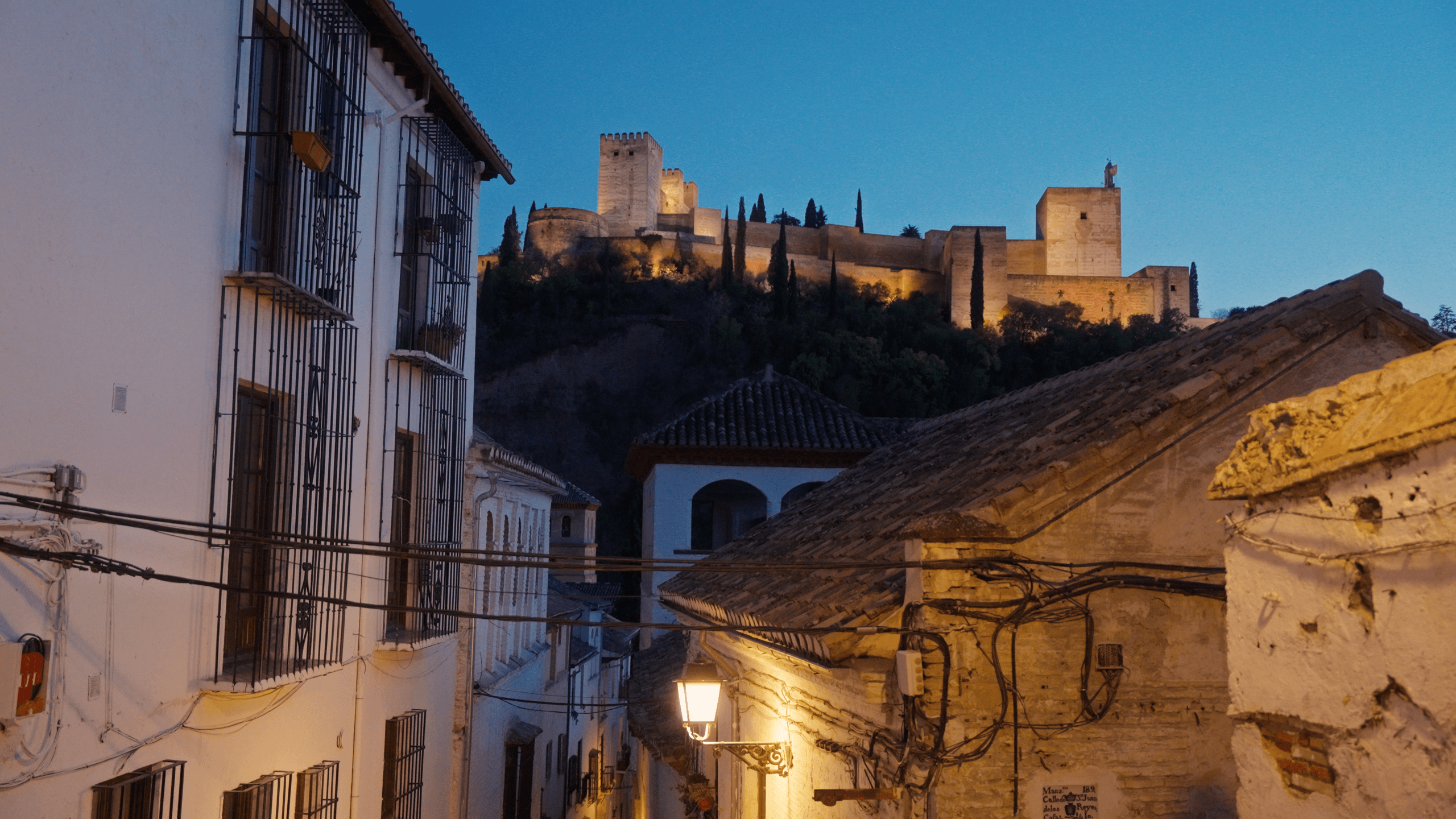
The Mirador de San Nicolás is one of the most famous tourist spots in Granada. It is in the middle-upper part of the Albaicín and has one of the most beautiful views of the Nasrid monument. Since Bill Clinton's visit, the place has become a tourist landmark of the city; he declared that here you see "the most beautiful sunset in the world".
What makes this viewpoint unique is not only its spectacular views, but that it sits on the oldest settlement in Granada city, with Iberian remains from the 7th century BC and a historical layering that runs through Iberians, Romans, Visigoths, Muslims and Christians.
Why the Mirador de San Nicolás is a must
In the Albaicín, a UNESCO World Heritage Site, this viewpoint offers the most complete panorama of the Alhambra, the Generalife and Sierra Nevada as a backdrop. It is the perfect balcony to contemplate how the city spreads over the Granada plain.
The festive atmosphere of the viewpoint is unmatched. Locals and tourists gather here to enjoy impromptu flamenco performances, street musicians and artists who create a unique bohemian atmosphere. The square fills up especially at sunset, when the golden light bathes the Alhambra in a visual spectacle that has inspired poets such as Federico García Lorca.
History of the Mirador de San Nicolás
In the area of the church, the remains of an Iberian temple area have been discovered, later reused as a Roman temple. The most incredible thing is that you can still see half of one of the columns of the Roman temple embedded in the corner of the bell tower, an archaeological treasure that many visitors walk past without noticing.
The story does not end there. After the Roman period a Visigothic temple was built here, and later, when the Arabs arrived, this place became something very special: the nerve centre of the Alcazaba Cadima. It was the first place inhabited by the sultans of Granada when the city became capital of this taifa kingdom. Basically, you are standing where the political power of Muslim Granada was born.
The leap to Christianity came in the 16th century, when the present church was built in the Mudéjar style, dedicated to Saint Nicholas of Bari. In the 19th century it was extended with the addition of the façade block, but things became difficult before the Civil War, when fires left it in ruins.
What is fascinating is the restoration just completed in 2024. The architects decided not to follow a traditional historicist approach, but to adapt the church to the times and bring together all branches of Christianity. It is a controversial but bold decision that reflects today's Granada: a city that respects its past while embracing the future.
What you can see at the Mirador de San Nicolás
The views that won over Bill Clinton
From the famous wall where everyone sits, you will have before you the most complete panorama of the Alhambra. To your left is the Generalife with its gardens, and to the right you can clearly make out the Peinador de la Reina, the Nasrid palaces and the Alcazaba. Sierra Nevada appears as a backdrop, especially spectacular in winter when it is covered in snow.
The church with the Roman secret
Do not just look at it from a distance. Go up to the Church of San Nicolás and look for that Roman column embedded in the corner of the bell tower. It is a unique testimony to how civilisations have been layered here over the centuries. The present church, built in 1525 on a mosque, masterfully combines Mudéjar and Gothic styles.
An unexpected corner of peace
Right next to the church you will find the Great Mosque of Granada, built in 2004. It is a perfect place to escape the bustle of the viewpoint while enjoying Arab pastries and still having views of the Alhambra. This coexistence of church and mosque represents exactly what Granada is: a melting pot of cultures.
The human spectacle
The viewpoint comes alive especially at sunset. Here you will see street musicians playing flamenco, couples enjoying the romance of the moment, artists painting the Alhambra and sellers of local crafts. It is like an open-air theatre where locals and tourists create a unique atmosphere together.
The details that go unnoticed
Notice the typical white houses of the Albaicín around the viewpoint, the architectural details of the façades and the Mediterranean vegetation framing the views. Even watch how the light changes throughout the day: each moment offers a different perspective of the Alhambra.
The best time to visit the viewpoint
Sunset is the magic moment par excellence. The golden light turns the Alhambra into a show of gold and pink tones that inspired Bill Clinton to call it the most beautiful sunset in the world. The viewpoint takes on a vibrant atmosphere full of life.
To avoid the crowds, consider visiting in the early morning or on weekdays. The views are just as spectacular and you can enjoy the peace to take photos without rushing.
At night, the illuminated Alhambra offers a completely different spectacle. The lights create dramatic contrasts that turn the landscape into a magical experience.
How to get to the Mirador de San Nicolás
By public transport, buses C31 and C32 take you there directly. Both lines pass through Plaza Nueva, the Paseo de los Tristes and the Carrera del Darro. Bear in mind that they are small minibuses holding about 20 people, so you may have to wait for the next one.
Walking up is a recommended experience if you have good legs. From Plaza Nueva, along the Paseo de los Tristes, up the Cuesta del Chapiz and turning left when you reach the Church of El Salvador. It is a very pleasant walk with lovely views, but a lot of uphill. Do not forget comfortable shoes: no heels or heavy boots.
By car it is complicated, as some streets are not well paved. You can park at the San Cristóbal car park (free) and walk about 10 minutes to the viewpoint.
What to do afterwards: a route through the Albaicín
Behind the church is one of the 16th-century cisterns, original hydraulic systems that supplied the neighbourhood for centuries. They are unique testimonies to Muslim engineering that few tourists know about.
A little further on are the Arco de las Pesas and the famous Plaza Larga, the commercial heart of the Albaicín, where residents still do their daily shopping. This is where the neighbourhood's authentic tapas area begins, with traditional bars that keep the Granada custom of a free tapa with every drink.
This onward route will take you through cobbled lanes where every corner tells stories of coexistence between cultures. The cármenes (houses with gardens) show the essence of the most authentic Albaicín, away from the tourist crowds.
Practical information for a guided visit to the Mirador de San Nicolás
The viewpoint is open 24 hours a day and access is free. The best times are sunrise and sunset for the best light. In summer, consider bringing water and sun protection, as there is little shelter from the sun.
For families, the space is safe, but keep an eye on small children near the wall, as there are no safety barriers. People with reduced mobility can get there with help, although the cobbled streets of the Albaicín make it harder.
Guided tours are available that include historical context on the site's archaeological layering and the coexistence of cultures. These tours usually end at the viewpoint as their high point.
Book your guided tour
Want to see it with an official guide telling you in person?